

 Nederlands
  Deutsch
  Français
  Italiano
  Español
Table of contents
1. What do O-rings do in a dental turbine?
2. Where are O-rings located in the dental turbine?
- O-rings in the coupling
- O-rings in the turbine head
- O-rings at bearings and spray channels
3. Material selection: EPDM vs. FKM/Viton®, silicone, and NBR
- Autoclavable/medical-grade O-rings
- EPDM or Viton® (FKM): when do you choose which?
4. Maintenance of O-rings in dental turbines: lubricating, cleaning, sterilizing
5. FAQ
What do O-rings do in a dental turbine?
In a dental turbine, O-rings provide air and water sealing, mechanical stability of the cartridge, and protection of internal components. They prevent pressure loss and hissing leaks, keep spray atomization predictable, and ensure the cartridge stays seated in the head without micro-play. That stability dampens noise and limits bearing load, causing the turbine to accelerate more evenly and require overhauls less quickly. Put simply: without good O-rings, you’ll sooner face leaks, unstable speed, and higher repair costs.
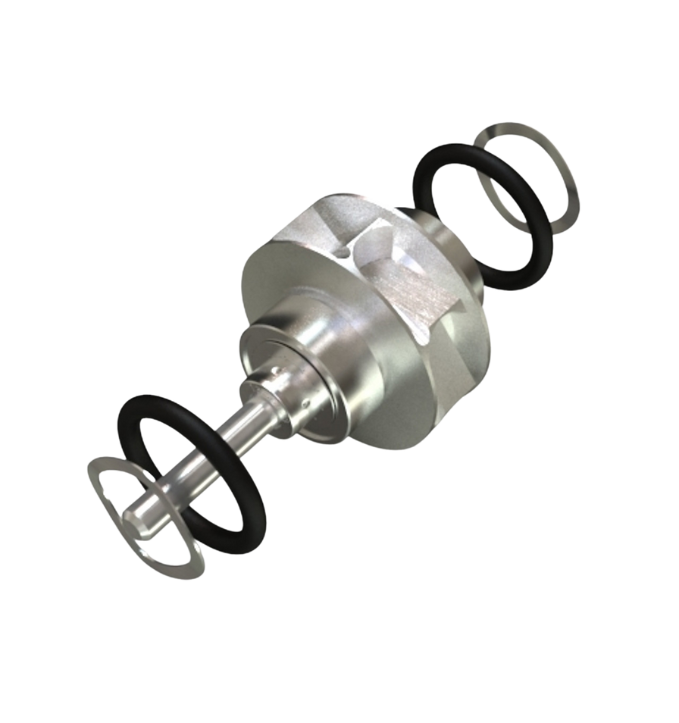
Where are O-rings located in the dental turbine?
O-rings in the coupling
In the coupling, the transition between unit hose and handpiece, you typically find one to three O-rings that seal the air and water channels. Wear on these rings is often immediately noticeable: a hissing sound when connecting, a film of water around the coupler, or a less powerful spray. Because these rings experience friction at every connect/disconnect and must withstand all sterilization cycles, they are among the parts most frequently replaced.
O-rings around the turbine head
Around the turbine head, and specifically around the cartridge or in the end cap, O-rings serve as retention and damping elements. They keep the cartridge centered and absorb micro-movements. If these rings become hard or develop flat spots, you can hear it in the turbine’s pitch and sometimes feel extra resonance. In practice, you usually replace them together with a new cartridge or during a head overhaul.
O-rings at bearings and spray channels
Some designs use small O-rings as micro-dampers around bearings or as seals at spray and air channels. Wear shows up as an irregular spray pattern, moisture where it should stay dry, or a slight rattle on spin-down. They need replacement less often than coupler rings, but are still worth checking when spray behavior becomes unpredictable.
Material selection for turbine O-rings: EPDM vs. FKM/Viton®, silicone and NBR
You choose the right material based on sterilization profile, chemical exposure, and mechanical loading. EPDM performs excellently under steam sterilization and aqueous cleaning and is also ozone- and UV-resistant. It is less suitable in contact with mineral oils or petroleum products. FKM/Viton® excels precisely in contact with oils, solvents, and many chemicals and remains dimensionally stable at higher temperatures; with prolonged wet steam, EPDM generally does slightly better, unless you opt for specifically autoclavable FKM compounds. Silicone (VMQ) is biocompatible and heat-resistant with a wide temperature range, but mechanically somewhat softer; with very many steam cycles it can slowly degrade. NBR is robust and oil-resistant, but ages faster under frequent steam and is more sensitive to ozone and UV.
Autoclavable/medical-grade O-rings for dental turbines
Prefer medical-grade compounds with documented performance at 121–134 °C, and adhere to the instrument manufacturer’s IFU. Those who sterilize frequently in practice usually opt for EPDM, or for silicone and FKM variants explicitly specified as autoclavable.
When do you choose EPDM and when Viton® (FKM)?
When there’s a lot of steam and aqueous cleaning, EPDM is the logical first choice. If the handpiece or coupling comes into contact with oil or more aggressive cleaning agents, FKM/Viton® offers greater assurance. If you’re unsure, follow the brand recommendation of your handpiece or coupler and use the same material throughout a single set.
Maintenance of O-rings in dental turbines: lubricating, cleaning, sterilizing
Good maintenance is about reducing friction, limiting compression set, and preventing chemical damage. Before sterilization, use a cotton swab to apply a thin film of manufacturer-approved handpiece oil or suitable silicone oil to the coupler rings. That minimal film is enough to prevent scuffing during coupling and helps keep the ring elastic in the autoclave. Install O-rings by rolling them into the groove and check that they sit flat without twist; use a plastic pick or a toothpick rather than a metal tip. Couple the handpiece straight and with slight rotation to avoid skiving. Avoid petroleum jelly and other petroleum products, as they cause swelling and drying and undermine the seal.
Recognize wear early and replace in time
During inspection, watch for hissing or visible leakage around the coupling; rings that have flattened and no longer spring back; cracks or a dull, hard surface; and extra noise or play from the head. In busy practices, replace coupler O-rings regularly and preferably preventively as part of your service cycle, think in weeks or months rather than years. Ideally, replace the rings around the cartridge at the same time as a cartridge change or when resonance and play become noticeable. Treat O-rings as consumables: inexpensive yet decisive for uptime and performance.
FAQ
Because coupler O-rings see the most friction and all sterilization cycles, they warrant a higher replacement frequency than other rings. Under intensive use, inspect them often and replace them preventively according to your service interval; in many practices that means every four to eight weeks. If you notice hissing, a water film, or a handpiece that feels loose, replace them immediately, preferably all rings in the set at once.
Use the handpiece oil specified by the manufacturer or a suitable silicone oil, and apply a thin film with a cotton swab. Too much oil is unnecessary and can attract contamination. Avoid petroleum jelly and other petroleum products; they cause swelling, saponification, and ultimately a poorer seal.
Autoclavability depends on material and compound. Choose medical-grade O-rings that, according to documentation and IFU, withstand 121–134 °C cycles. In practice, EPDM and certain VMQ and FKM grades perform well under repeated steaming. Keep the same material within a single set to avoid differences in compression and ageing behavior.
That depends on your working environment. Use EPDM when steam sterilization and aqueous cleaning dominate. Choose FKM/Viton® as soon as oil or more aggressive chemicals come into play. For a soft static seal with limited movement, silicone (VMQ) is convenient, while NBR is attractive for its robustness and price, but with shorter intervals if you sterilize frequently.