

 Nederlands
  Deutsch
  Français
  Italiano
  Español
How does RGD damage occur?
Under high pressure, gas dissolves in rubber and slowly diffuses through the material. As long as the pressure remains stable, the O-ring can retain its sealing function. The problem arises when the external pressure drops rapidly, for example during blowdown, emergency relief or rapid pressure cycling.
The gas inside the O-ring then expands faster than it can escape from the elastomer. This creates internal stress. Minor damage may appear as pitting or small blisters on the surface. More severe damage can cause cracks, splits or delamination within the cross-section. The seal may then start to leak, even if the material was chemically compatible with the gas medium.
The severity depends on pressure, temperature, exposure time, decompression rate, gas mixture and compound composition. Hydrogen, natural gas, CO2, H2S and mixed hydrocarbons therefore each require their own assessment.
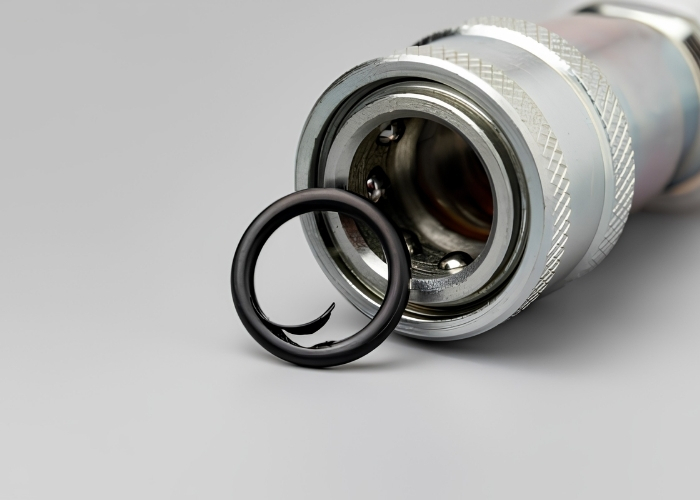
When are AED/RGD-resistant O-rings required?
AED/RGD-resistant O-rings are particularly relevant in high-pressure gas environments. Examples include valves, manifolds, wellheads, subsea systems, compressors, pressure vessels, downhole tools and hydrogen installations. Industrial systems with regular pressure fluctuations may also be at risk of RGD.
This is therefore not a standard choice for every installation, but it becomes important whenever rapid depressurisation is possible. An application with stable low pressure requires a different approach from a system that is periodically blown down. Do not only consider the medium, but also the pressure profile and the consequences of seal failure.
Materials for high-pressure gas
AED/RGD-resistant O-rings are often made from HNBR, FKM or FFKM. However, the material name alone is not sufficient. A standard HNBR or FKM O-ring is not automatically suitable for rapid gas decompression. Only a compound that has been formulated and tested for this purpose can be regarded as a substantiated choice.
For AED/RGD-resistant O-rings in oil and gas applications, HNBR is often a practical starting point. The material combines mechanical strength with good resistance to many hydrocarbons. HNBR is therefore widely used in valves, actuators and downhole components.
FKM is of interest under chemical exposure, higher temperatures and where low gas permeability is required. Special FKM compounds may be suitable for AED/RGD-resistant O-rings, but always ask for the compound code and test range. The name FKM or Viton is not a qualification in itself.
For extreme chemical exposure or high temperatures, FFKM becomes relevant. This material offers the broadest chemical resistance, but the same rule applies: AED/RGD-resistant O-rings made from FFKM must be tested at compound level. At high pressure, PTFE back-up rings are also often used to reduce extrusion through the groove clearance.
Standards and documentation
NORSOK M-710 and ISO 23936-2 are the main reference frameworks used for AED/RGD-resistant O-rings. These standards help assess elastomers for oil, gas and high-pressure applications. They consider not only material compatibility, but also test conditions, ageing, gas exposure and decompression behaviour.
Always ask which standard, test method and classification apply. A general datasheet is often insufficient for critical gas service. You need to know which compound was tested, at what pressure and temperature, with which gas mixture and according to which assessment criteria.
Selection: what should you consider?
AED/RGD-resistant O-rings must be selected based on the complete application. Start with the gas medium and maximum pressure. Then define the temperature, pressure cycles, blowdown rate, groove design, extrusion gap and required service life. Only then should you select the material, hardness and any back-up rings.
For AED/RGD-resistant O-rings, always request compound-specific documentation. This may include RGD test reports, material certificates, batch information and any project qualifications. This is particularly important in oil & gas, hydrogen and safety-critical installations and helps prevent discussions afterwards.
O-ring Stocks helps find O-rings for gas, high pressure, oil & gas and hydrogen. Share the application, pressure, temperature, medium and documentation requirements, and we will help assess which compound is technically the best fit.
FAQ
RGD is the damage process caused by rapid pressure reduction. AED describes the resistance of a compound to that process.
No. Only a specifically tested FKM compound may be considered RGD- or AED-resistant.
Not automatically. Hydrogen requires a separate assessment of the compound, permeation, pressure, temperature and test documentation.
Request a test report for high gas pressure, rapid blowdown, sour service, hydrogen or project specifications where qualification is mandatory.