

 Nederlands
  Deutsch
  Français
  Italiano
  Español
Table of contents
Role and function of O-rings for mechanical seals
- Secondary seals: static vs. dynamic (pusher/non-pusher)
- Self-energising & compression (ISO 3601 groove dimensions)
- Common failure modes: RGD, extrusion, compression set
Material selection for oil & gas
- HNBR O-ring vs. FKM O-ring (temperature, sour service)
- AFLAS® O-ring & FFKM O-ring (extreme chemicals, H2S/amine/steam)
- AED-resistant O-ring (RGD): when required
Design & installation
- PTFE back-up ring: for high differential pressure/pressure
- Hardness (70-90 Shore A), roughness & lubrication
- Groove design checklist according to ISO 3601
Standards & selection: O-rings for mechanical seals
- API 682/ISO 212049 (seals), implications for O-rings
- NORSOK M-710 / ISO 23936-2 & NACE TM0297 (AED/RGD)
Role and function of O-rings for mechanical seals
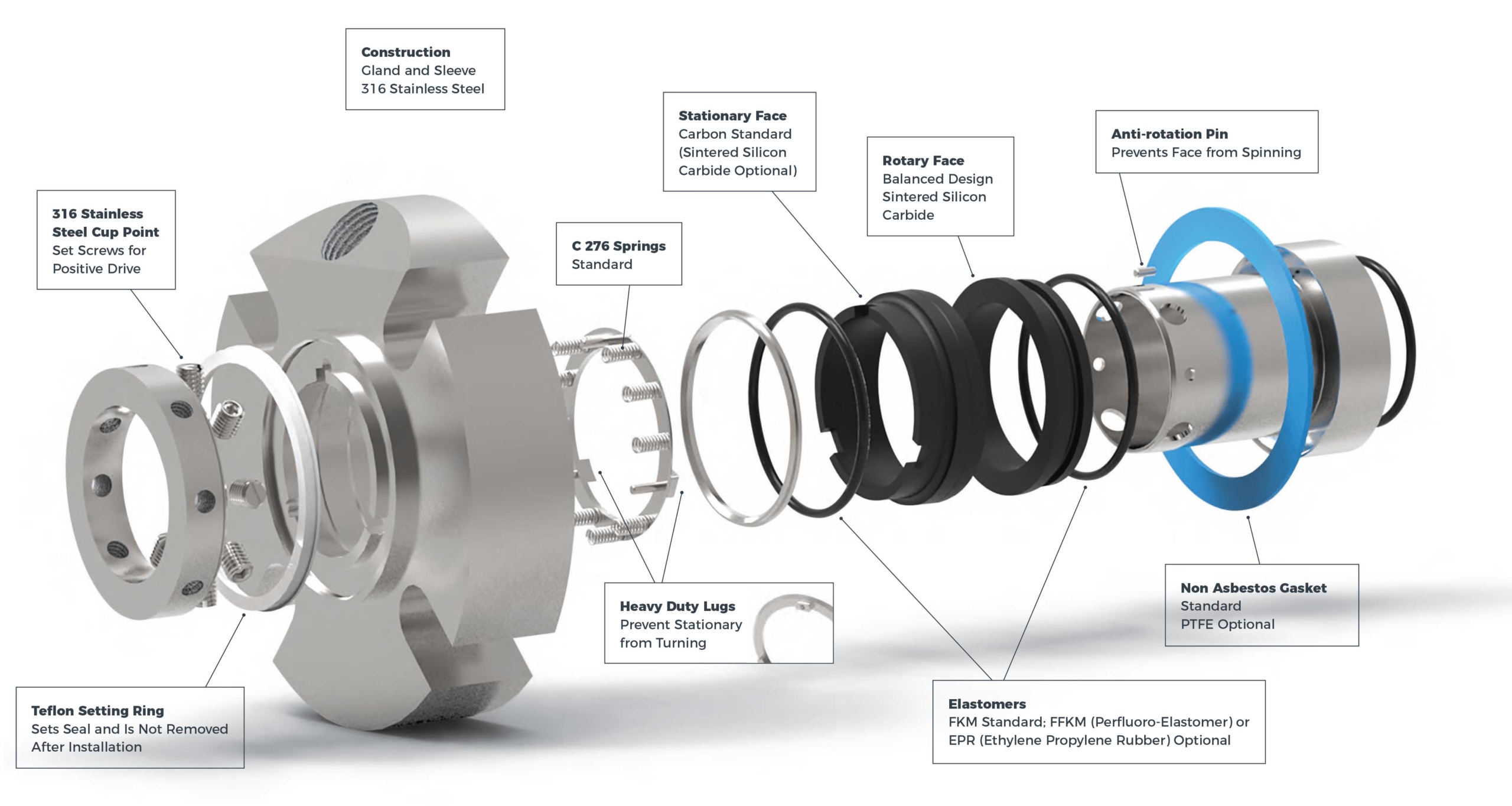
O-rings for mechanical seals close off leakage paths outside the primary seal faces. In static positions, they provide pressure-tight sealing between components. In dynamic positions, they may move along the shaft or sleeve. This requires control of friction, lubrication and surface roughness. In pusher designs, the O-ring for mechanical seals moves dynamically with the assembly. Select an installation and operating lubricant that is compatible with the compound.
Secondary seals: static vs. dynamic (pusher/non-pusher)
In static positions, the focus is on predictable compression, material stability and burr-free grooves. In dynamic positions, stick-slip must be minimised through the correct roughness and fit, so that the O-ring for mechanical seals does not “hang”. Consider tolerance stack-ups and thermal expansion between the shaft and gland.
Self-energising & compression (ISO 3601 groove dimensions)
Process pressure presses the O-ring more firmly against the leakage path through a self-energising effect. The groove geometry converts pressure into sealing force, and excessive or insufficient compression immediately affects performance. An O-ring for mechanical seals must have low compression set so that it retains its recovery force. Check whether the O-ring for mechanical seals fits the ISO 3601 groove dimensions. This prevents excessive friction or insufficient preload.
Common failure modes: RGD, extrusion, compression set
RGD (rapid gas decompression) can be recognised by blistering or cracking after a rapid pressure drop. Extrusion appears as shearing into the clearance under high differential pressure, while high compression set causes permanent “flattening”. RGD damage occurs when an O-ring for mechanical seals is not AED-resistant. Limit extrusion with back-up rings and select compounds that retain their elastic properties throughout the temperature profile.
Material selection for oil & gas
The medium, including hydrocarbons, H₂S/CO₂, amines and steam, and the temperature profile determine the material selection. The O-ring for mechanical seals must remain stable without swelling, hardening or cracking, including during pressure fluctuations and cleaning regimes.
HNBR, FKM, AFLAS® & FFKM (temperature, sour service & extreme chemicals)
HNBR performs particularly well in sour service and offers strong mechanical robustness, including reliable performance with H₂S-rich gases and during cold starts. FKM (Viton®) performs well at higher temperatures and in solvents. At 150–200 °C, an FKM O-ring for mechanical seals often performs better. AFLAS® (FEPM) offers strong resistance to amines, hot steam and H₂S. For sour service, an O-ring made from HNBR or AFLAS® is a logical choice. FFKM provides maximum chemical and heat resistance. An FFKM O-ring for mechanical seals is worthwhile under extreme chemical and thermal conditions. Always base the selection on the worst-case operating window, including start-ups, upset conditions and cleaning.
Design & installation
Clearance, alignment and thermal expansion determine the actual load. An O-ring for mechanical seals benefits from a consistent fit, correct surface roughness and compatible installation lubrication.
PTFE back-up ring: for high differential pressure/pressure
The differential pressure and clearance determine the risk of extrusion. At high differential pressure, an O-ring for mechanical seals should be combined with back-up rings. The back-up rings bridge the clearance so that the elastomer is not squeezed out, including during pressure peaks. With PTFE back-up rings, the O-ring for mechanical seals remains protected against extrusion under high pressure.
Hardness (70-90 Shore A), roughness & lubrication
A harder material, such as 90 Shore A, helps resist extrusion, while a softer material follows the surface roughness more effectively. Match the roughness to the dynamic conditions: a surface that is too rough causes wear, while one that is too smooth increases stick-slip. Select a grease or oil that does not cause the compound to swell. This allows the O-ring for mechanical seals to retain its preload and service life.
Groove design checklist according to ISO 3601
Verify dimensions, tolerances and angles before ordering or installation. Check whether the O-ring for mechanical seals fits the ISO 3601 groove dimensions. Include chamfers and burr-free edges to prevent cutting damage and ensure sufficient groove volume for thermal expansion.
Standards & selection: O-rings for mechanical seals
Standards provide a common language between engineering and purchasing. The O-ring for mechanical seals must not only fit; its suitability must also be demonstrable.
API 682/ISO 21049 (seals), implications for O-rings
These standards guide seal configurations, material selection and testing. Translate these requirements into the parts list: which O-ring for mechanical seals, including compound and hardness, which back-up rings and which piping plan. Record the temperature, pressure and medium windows in the datasheet.
NORSOK M-710 / ISO 23936-2 & NACE TM0297 (AED/RGD)
Request test reports for sour service and RGD. An AED-resistant O-ring with NORSOK/ISO qualification reduces the risk of unplanned shutdowns during depressurisation. Also specify how quickly the pressure may be reduced during maintenance and start-up.
FAQ
No. Due to compression set, micro-damage and contamination, reuse is unreliable, especially in critical mechanical seals. Always replace with a new O-ring for mechanical seals from the same batch/compound.
Measure the inside diameter and cross-section with a precise caliper and choose one system: ISO 3601 (metric) or AS568 (inch). Do not mix them; grooves are designed specifically for one or the other.
Cool, dark, dry, in sealed original packaging; away from ozone/UV and solvent vapors. Apply FIFO, keep batch labels/CoC, and follow the supplier’s shelf life.
Don’t do this in this application. For mechanical seals, you want molded, endless rings; bonded splices are weak points, especially under pressure and temperature fluctuations.