

 Nederlands
  Deutsch
  Français
  Italiano
  Español
Table of contents: O-rings for valves
- General information about O-rings for valves (locations, functions and application examples)
- Drinking water O-rings: material selection (EPDM vs. FKM/FFKM) and WRAS/NSF 61
- Design according to ISO 3601: groove dimensions, compression and PTFE back-up rings
- Installation and maintenance: assembly, lubrication and leak prevention
- FAQ
General information about O-rings for valves (locations, functions and application examples)
Anyone working in water and wastewater treatment will find O-rings for valves in fixed locations: around the stem (stem seal), between the body and bonnet (bonnet/cover seal), at service covers and at the interface with the actuator. In butterfly valves, O-rings are often installed above and below the stem to ensure a dry passage. In gate valves, they are generally located on the bonnet, allowing the valve to be sealed without a flat gasket. Ball and plug valves use O-rings for the stem seal and sometimes as a “seat energizer”: an O-ring that preloads the seat so that the valve seals even at low pressure. In check valves, O-rings are used for the service cover, allowing inspection and maintenance to be carried out quickly. O-rings for valves in this industry are therefore primarily used for reliable static sealing, with slow dynamic movement during operation. This may appear straightforward, but water hammer, pH fluctuations and oxidative disinfection create a greater service-life load than in many other industries. For this reason, the following sections always consider O-rings for valves in relation to the medium, design and maintenance.
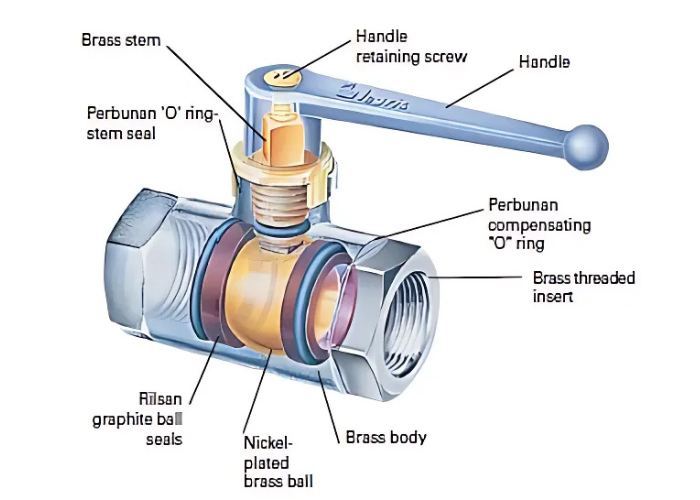
Anyone working in water and wastewater treatment will find O-rings for valves in fixed locations: around the stem (stem seal), between the body and bonnet (bonnet/cover seal), at service covers and at the interface with the actuator. In butterfly valves, O-rings are often installed above and below the stem to ensure a dry passage. In gate valves, they are generally located on the bonnet, allowing the valve to be sealed without a flat gasket. Ball and plug valves use O-rings for the stem seal and sometimes as a “seat energizer”: an O-ring that preloads the seat so that the valve seals even at low pressure. In check valves, O-rings are used for the service cover, allowing inspection and maintenance to be carried out quickly. O-rings for valves in this industry are therefore primarily used for reliable static sealing, with slow dynamic movement during operation. This may appear straightforward, but water hammer, pH fluctuations and oxidative disinfection create a greater service-life load than in many other industries. For this reason, the following sections always consider O-rings for valves in relation to the medium, design and maintenance.
Drinking water O-rings: material selection (EPDM vs. FKM/FFKM) and WRAS/NSF 61
The basic rule for drinking water is clear: select compounds that comply with the applicable scheme for hygiene, migration and taste/odour. KIWA and WRAS/BS 6920 are frequently encountered in the Netherlands and the United Kingdom, while NSF/ANSI/CAN 61 is common in North America. For drinking water O-rings, EPDM is usually the first choice because it performs exceptionally well in water and resists ozone, chlorine and chloramines within commonly used concentrations and temperatures. EPDM O-rings are also widely available as WRAS-certified O-rings and NSF 61 O-rings, including variants with low compression set. O-rings for valves used with sodium hypochlorite or chlorine dioxide dosing require additional attention: compatibility depends on the pH, temperature and concentration. In these situations, a high-quality EPDM compound or, where the chemistry and temperature require it, an inert solution incorporating PTFE or FFKM is a sensible option. FKM (Viton®) may be useful where exposure to oil and fuel occurs in pump environments, but it is less suitable for hot water, steam and strong oxidising agents. It should therefore be used selectively.
For wastewater and sludge, where H₂S and organic components are present, EPDM often performs well, but the process conditions must be checked. At higher temperatures or in the presence of solvents, FKM or FFKM should be considered. Operators preparing for audits should explicitly request WRAS-certified O-rings and check whether the EPDM O-rings combine low compression set with the correct Shore hardness. Under higher oxidative loads, selecting chlorine-resistant O-rings is worthwhile, or O-rings for valves can be combined with PTFE inserts when the temperature and concentration increase. EPDM O-rings and drinking water O-rings for valves therefore form a link between compliance and reliability: selection is based not only on chemical resistance, but also on the required certificates and service life within the relevant cleaning, flushing and disinfection cycle.
Design according to ISO 3601: groove dimensions, compression and PTFE back-up rings
Correct material selection depends on proper groove design. ISO 3601-1 defines the standard dimensions for O-rings for valves, while ISO 3601-2 provides guidelines for groove dimensions. In practice, three parameters are controlled: squeeze (axial or radial compression), gland fill (the percentage of the groove filled by the O-ring) and stretch/diametral clearance.
For water applications, 70 Shore A is often a good starting point, with sufficient squeeze to ensure leak-tightness without overloading the O-ring. At higher pressures or with an enlarged “gap” between metal components, the risk of extrusion increases. Extrusion occurs when the O-ring is forced into the gap and becomes damaged. This is where PTFE back-up rings are used. These supporting elements for O-rings for valves, described in ISO 3601-4, support the O-ring on one or both sides, reduce the effective gap and absorb pressure peaks. In piping systems affected by water hammer or frequent switching, a 90 Shore A O-ring with PTFE back-up rings is often the safest choice. This increases the operational reliability of O-rings for valves in networks with fluctuating pressure.
Keep in mind that O-rings for valves also affect the operating torque: excessive friction in the stem seal can cause stick-slip. A thin layer of lubricant approved for drinking water reduces this friction without compromising the seal. O-rings for valves dimensioned according to ISO 3601, with the correct hardness and back-up configuration, withstand pressure cycles more effectively and retain their shape, making maintenance intervals more predictable.
Installation and maintenance: assembly, lubrication and leak prevention
Most leaks encountered in the field are caused less by the “wrong material” than by installation errors. Start with a clean, burr-free groove. Even small burrs or sharp edges can cut into the elastomer during installation. Use an installation tool or chamfers to prevent the O-ring from twisting when it is moved over threads or sharp transitions. Apply a small amount of lubricant suitable for drinking water to prevent friction and microcracking during installation. For the valve stem seal, use a thin layer of assembly grease approved for drinking water. For dosing lines containing oxidising agents, switching to chlorine-resistant O-rings can prevent unnecessary failures. O-rings for valves benefit from consistent tightening torques on covers, the bonnet seal and service covers, as uneven compression creates local leakage paths.
After commissioning, a brief visual inspection is useful, particularly in systems containing NaOCl or ClO₂. Oxidising media accelerate ageing when the concentration or temperature is unexpectedly high. If compression set, a permanently “flattened” profile, is observed, reduce the gland fill or select a compound with better compression-set properties. If signs of extrusion or cut-off lips are visible, reduce the gap or install PTFE back-up rings. O-rings for valves are relatively inexpensive, so preventive replacement based on operating hours or switching cycles, rather than calendar years alone, should be planned for critical assets. Record batch numbers, compound codes and certificates so that exactly the same quality can be installed during the next shutdown. With this discipline, O-rings for valves continue to perform predictably, the risk of failure decreases and drinking water or effluent quality remains assured.
FAQ
EPDM is generally the first choice. Make sure you select a drinking-water grade with WRAS or NSF 61 certification, and that the valve O-rings also match your groove in terms of hardness and compression set. For critical points under WRAS/BS 6920, WRAS-certified O-rings are often required.
If you work with higher pressure, have a larger gap, or expect pressure spikes/water hammer. PTFE back-ups limit extrusion and extend service life. For many butterfly and gate valves in networks, this is a sensible standard, especially for Butterfly Valve O-rings and Gate Valve O-rings that face pressure peaks.
Not necessarily. FKM performs well with oils/fuels but is less suitable for hot water/steam and some oxidizers. For chlorine or chloramine dosing, a suitable EPDM grade or, under severe conditions, an inert solution (e.g., PTFE insert or FFKM) is often better. In dosing lines with higher oxidative load, chlorine-resistant O-rings with validated test data can provide a solution.
The stem seal contributes to friction. Choose a suitable compound, size the groove according to ISO 3601, and use a drinking-water-approved lubricant to prevent stick-slip and keep the torque stable. This keeps valve O-rings in top condition, even with frequent actuations.
That depends on switching frequency, medium, and temperature. In critical lines (disinfection, inlet), a preventive replacement during scheduled shutdowns is advisable. Inspect for compression set, cracks, and signs of extrusion; replace if in doubt. O-rings for valves are inexpensive compared to the cost of unplanned downtime.
Keep batch and compound codes, certificates (WRAS/KIWA/NSF 61), any test reports, and a note of groove dimensions and tightening torques. This allows you to demonstrate that O-rings for valves meet the requirements, perform reproducibly, and that the O-rings for valves are traceable.