430.000.000+ O-rings in stock
Fast delivery


 Nederlands
  Deutsch
  Français
  Italiano
  Español
O-ring vacuum sealing works fundamentally differently from standard overpressure applications. The ring must not only seal a pressure boundary, but also counteract the diffusion of gas molecules through the rubber. In overpressure applications, the working pressure helps: it presses the ring more firmly into place. In O-ring vacuum sealing, that help is completely absent. The ring must seal based on its own elastic preload, while at the same time the diffusion path through the elastomer must be made as long as possible. This places different demands on the groove, the surface and the material selection than in normal static applications.
At positive pressures, the pressure helps: it presses the O-ring harder against the sealing surfaces. Under vacuum, that help is completely absent. The ring must seal solely on the basis of its own elastic preload, and that preload is determined by the groove geometry and the surface finish. At the same time, in vacuum applications not only the tightness of the contact zone is relevant, but also the diffusion path through the elastomer itself. Gas molecules can, especially at lower molecular weight, diffuse through the rubber without there being a classic leak path. To limit this, the groove is dimensioned so that the ring fills the groove approximately 100%. The smaller the free volume in the groove, the longer the diffusion path through the material, and the lower the total leak rate of the system.
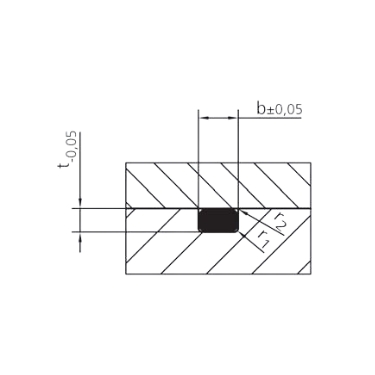
The groove for vacuum sealing is superficially similar to the standard rectangular groove, but there are three critical differences. The tolerance on t is negative instead of positive: the groove must be slightly shallower than the nominal dimension. The tolerance on b is symmetrical and tighter. And the radii r1 and r2 are smaller than in the standard groove. Together, these choices ensure a higher preload and a fuller groove during assembly.
This is the most striking difference compared with the standard groove. The tolerance on t is negative: the groove must meet the nominal dimension, but may be up to 0.05 mm shallower. Never deeper. A shallower groove gives a higher radial compression during assembly and ensures that the ring fills the groove more densely. That is exactly the intention in vacuum: more rubber in the groove, less free volume, less diffusion path.
The groove width has a symmetrical tolerance of ±0.05 mm. That is the tightest width tolerance of all groove types in this document. The reason is the same as for t: the width must not be too generous, because excess volume in the groove increases the diffusion path. A groove that is too narrow does not allow the ring to deform sufficiently and damages the rubber during assembly.
The base radius r1 is smaller in vacuum grooves than in the standard groove: 0.2 mm for d2 up to 3.00 mm, and 0.4 to 0.6 mm for larger sizes. r2 is likewise 0.1 to 0.2 mm. The smaller radii contribute to a fuller groove profile. They also increase the contact pressure in the corners, which is beneficial for sealing performance under vacuum.
In addition to the groove geometry, there are three additional measures that further reduce the leak rate under vacuum. These measures are not mandatory, but they are recommended for higher vacuum requirements, such as at process pressure levels below 10-3 mbar or in analytical and medical instrumentation.
Two O-rings in series. Two O-rings in series significantly lengthen the diffusion path. The space between the two rings can also be connected to a vacuum pump or filled with vacuum grease, which further reduces the leak rate.
Vacuum grease. Applying a thin layer of vacuum grease to the ring and the sealing surface reduces diffusion through the surface contact and improves assembly conditions. Use only grease that is compatible with the rubber and with the vacuum process.
Better surface quality. Under vacuum, stricter roughness values apply: sealing surface Ra max. 0.8 µm (Rz max. 1.6 µm). This is tighter than the standard static values of Ra max. 1.6 µm.
In many vacuum seals, O-rings made of fluororubber (FKM, also known as Viton) have proven their effectiveness. FKM has low gas permeability compared with NBR or EPDM, which limits diffusion leakage. In addition, FKM is resistant to most cleaning chemicals used in vacuum systems. NBR can be used for simple vacuum systems without aggressive media. EPDM can be used with water vapor and certain solvents, but has a higher gas permeability than FKM.
Consult the chemical resistance guide for your specific medium and vacuum level.
| d2 | t -0,05 | b ±0,05 | r1 |
| 1,50 | 1,05 | 1,80 | 0,2 |
| 1,78 | 1,25 | 2,10 | 0,2 |
| 1,80 | 1,25 | 2,10 | 0,2 |
| 2,00 | 1,40 | 2,35 | 0,2 |
| 2,50 | 1,75 | 2,90 | 0,2 |
| 2,60 | 1,80 | 3,05 | 0,2 |
| 2,62 | 1,85 | 3,05 | 0,2 |
| 2,65 | 1,85 | 3,10 | 0,2 |
| 2,70 | 1,90 | 3,15 | 0,2 |
| 2,80 | 1,95 | 3,30 | 0,2 |
| 3,00 | 2,10 | 3,50 | 0,2 |
| 3,10 | 2,20 | 3,60 | 0,4 |
| 3,50 | 2,45 | 4,10 | 0,4 |
| 3,53 | 2,50 | 4,10 | 0,4 |
| 3,55 | 2,50 | 4,15 | 0,4 |
| 3,60 | 2,50 | 4,20 | 0,4 |
| 3,70 | 2,60 | 4,30 | 0,4 |
| 4,00 | 2,80 | 4,70 | 0,4 |
| 4,50 | 3,15 | 5,30 | 0,4 |
| 5,00 | 3,50 | 5,90 | 0,4 |
| 5,30 | 3,70 | 6,30 | 0,4 |
| 5,33 | 3,70 | 6,30 | 0,4 |
| 5,50 | 3,85 | 6,50 | 0,4 |
| 5,70 | 4,00 | 6,70 | 0,4 |
| 6,00 | 4,20 | 7,10 | 0,4 |
| 6,50 | 4,60 | 7,60 | 0,6 |
| 6,99 | 4,90 | 8,20 | 0,6 |
| 7,00 | 4,90 | 8,20 | 0,6 |
| 7,50 | 5,30 | 8,70 | 0,6 |
| 8,00 | 5,60 | 9,40 | 0,6 |
| 8,40 | 5,90 | 9,90 | 0,6 |
| 8,50 | 6,00 | 10,00 | 0,6 |
| 9,00 | 6,40 | 10,50 | 0,6 |
| 9,50 | 6,70 | 11,10 | 0,6 |
| 10,00 | 7,10 | 11,70 | 0,6 |
A shallower groove gives a higher radial compression and ensures that the ring fills the groove more densely. Less free volume means a longer diffusion path for gas molecules through the rubber, which reduces the leak rate.
Yes, the ring itself is the same. Only the groove and the surface are different. Do use the right material choice: FKM has the lowest gas permeability and is therefore the preferred option for higher vacuum requirements.
With a properly designed vacuum groove, an FKM O-ring, vacuum grease and double rings, a leak rate of 10-8 mbar·l/s is achievable. For higher requirements (10-10 and lower), metal or PTFE seals are required.
FKM has lower gas permeability than NBR or EPDM, which means less gas diffuses through the material itself. In addition, FKM is resistant to most cleaning chemicals used in vacuum systems and has low outgassing at low pressures.