430.000.000+ O-rings in stock
Fast delivery


 Nederlands
  Deutsch
  Français
  Italiano
  Español
O-rings in the food industry, pharmaceutical sector and medical applications must meet stricter requirements than standard industrial seals. With food & pharma certifications for O-rings, it is not only about the base material, but especially about the specific compound, application and corresponding documentation.
An O-ring made of EPDM, FKM, silicone or PTFE is therefore not automatically suitable for food contact or pharmaceutical use. The question is always: does the O-ring come into direct or indirect contact with product, cleaning agent, steam or process water? And which declaration, standard or certification does the installation, customer or end market require?
With food & pharma certifications for O-rings, you often come across terms such as FDA, EC 1935/2004, USP Class VI, 3-A Sanitary Standards and BfR. These terms are sometimes used interchangeably, but they do not mean the same thing. Some relate to food contact, others to biological reactivity, hygienic design or material guidelines.
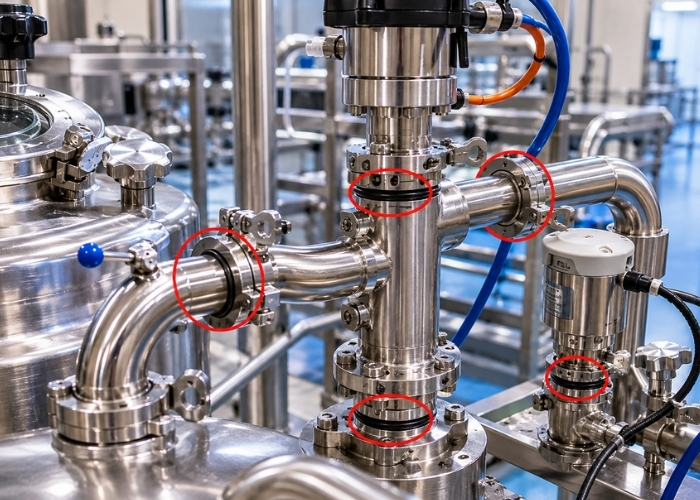
Food & pharma certifications for O-rings are especially relevant when seals are used in equipment where product safety, cleanability and traceability are important. Think of filling machines, pumps, valves, couplings, dosing systems, tanks, pipelines, mixers and process installations.
In the food industry, the focus is often on food contact. A seal must not release unwanted substances into the product and must be suitable for the operating conditions. Temperature, fats, acids, cleaning agents and steam can influence the material choice.
In pharmaceutical and medical applications, the emphasis is often stronger on documentation, reproducibility and risk analysis. That is why food & pharma certifications for O-rings are important in applications where hygiene, biocompatibility or controlled production conditions play a role.
For food & pharma certifications for O-rings, FDA, EC 1935/2004, USP Class VI, 3-A and BfR are especially important. Below is a brief explanation of what these standards and guidelines mean.
FDA is widely used as an indication for materials that are suitable for food contact under American regulations. For O-rings, this usually concerns the composition of the compound and the permitted substances for repeated food contact. Important: “FDA” does not automatically mean that every version of a material is suitable.
EC 1935/2004 is a European framework regulation for materials and articles intended to come into contact with food. For O-rings, this means that the material must not, under normal or foreseeable conditions, release substances that endanger health or undesirably affect the composition, smell, taste or appearance of food.
USP Class VI is mainly used in pharmaceutical, medical and bioprocess applications. This classification relates to biological reactivity tests. A USP Class VI O-ring is therefore not automatically the same as a food grade O-ring.
3-A Sanitary Standards focus on the hygienic design of equipment, especially within food, dairy and process installations. For seals, this is relevant because an O-ring must not only be suitable from a material perspective, but also fit into a hygienic design without areas that are difficult to clean.
BfR recommendations are often used for food contact materials, including rubber and silicone. Within food & pharma certifications for O-rings, BfR is especially relevant when customers or markets specifically ask for German or European substantiation for food contact materials.
|
Standard / certification |
Especially relevant for |
Commonly used materials |
When important? |
|
FDA |
Food contact, export to the US |
EPDM, FKM, silicone, PTFE |
In food processing and American requirements |
|
EC 1935/2004 |
European food contact |
EPDM, FKM, silicone, PTFE |
For contact with food within the EU market |
|
USP Class VI |
Pharma, medical, bioprocess |
Silicone, EPDM, FKM, PTFE |
For biological reactivity and pharma documentation |
|
3-A |
Hygienic design |
Silicone, EPDM, PTFE |
For dairy, food equipment and cleanability |
|
BfR |
Food contact materials |
Silicone, rubber compounds |
For German/EU-oriented material assessment |
Commonly used materials include EPDM, FKM, silicone, FFKM and PTFE. EPDM is often chosen for water, steam and cleaning processes. FKM is interesting for oils, fats and chemical exposure. Silicone is widely used because of its temperature range and flexibility, while PTFE is strong in chemical resistance and low friction.
Still, the compound remains decisive. Two O-rings made from the same base material can have different approvals. Therefore, always ask for the correct documentation, such as a material declaration, declaration of conformity or certificate per compound. This makes food & pharma certifications for O-rings practically applicable instead of just a general claim.
For food & pharma certifications for O-rings, always check:
Are you unsure which O-ring or certification is needed? Request technical advice. This helps prevent a seal from appearing suitable from a material perspective, while still not meeting the requirements of your application.
Food & pharma certifications for O-rings indicate which standards, declarations or test criteria are relevant for seals in food contact, pharmaceutical or medical applications. They say something about material suitability, documentation and application.
Not automatically. FDA refers to American regulations. For European food contact applications, EC 1935/2004 or additional documentation may be required.
FDA is often used for food contact. USP Class VI concerns biological reactivity and is mainly used in pharmaceutical and medical applications.
Commonly used materials include EPDM, FKM, silicone, PTFE and sometimes FFKM. The right choice depends on the medium, temperature, cleaning process and required certification.