

 Nederlands
  Deutsch
  Français
  Italiano
  Español
Table of contents
- Where are O-rings located in the control block of a dental unit?
- O-ring material selection for dental control blocks
- Step-by-step guide: replacing an O-ring in the valve block
- Common leaks and symptoms involving O-rings in the air-water block
Where are O-rings located in the control block of a dental unit?
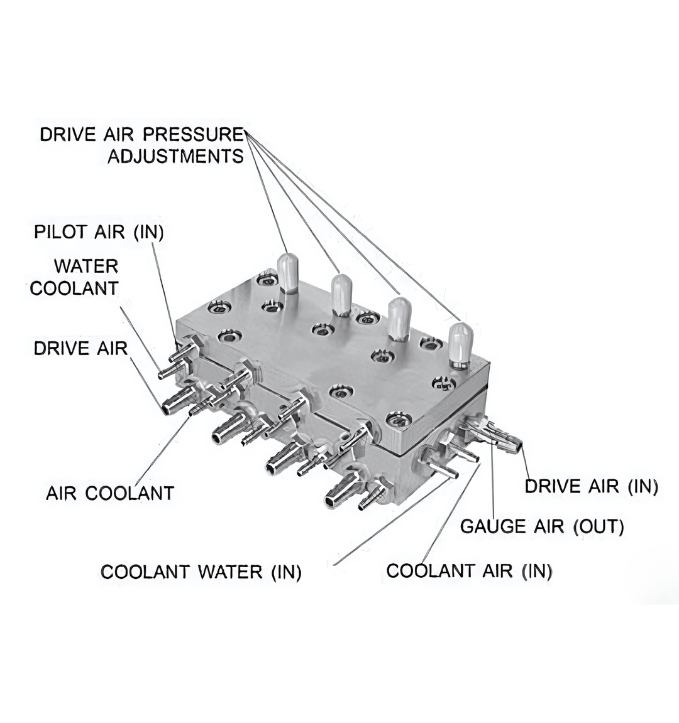
Under each solenoid is a static seal that seals the valve base against the aluminium block. As soon as this ring hardens or a burr develops on the contact surface, you may hear a soft hissing sound or notice traces of moisture. O-rings in the control block of a dental unit provide pressure-tight, silent operation here. Replacement only provides a lasting solution when the seat is made clean and free from scratches and the correct tightening torque is used.
Inside the valve, small rings provide a dynamic seal around the spool or plunger. When worn, air or water continues to flow through, causing instruments to drip or operate at half power. In practice, a complete overhaul kit is more reliable than replacing a single ring, especially with compact cartridge valves such as those often found in Dentsply Sirona units. This restores the valve’s closing performance and response time to the factory level.
Service plugs also use flat seals to separate individual channels inside the block. A damaged ring allows pressure to escape or causes crossinteraction, in which an instrument that has not been selected briefly activates. O-rings in the control block of a dental unit are invisible workhorses in this area. A clean groove, a new ring and the correct tightening torque solve most problems without further adjustments.
Many units use a modular manifold. Flat rings between these sections separate the parallel air and water passages. If they become crushed or displaced, performance differences arise between instrument lines that appear identical. Assemble the sections crosswise, remove micro-burrs and check the mating surface. This keeps the air-water block stable across its entire width.
Push-in fittings grip the outside diameter of the hose and seal with an internal O-ring. Wear or chemical attack causes microleakage, resulting in an unstable spray, fluctuations in rotational speed and more rapid pressure loss. Replace the internal ring, cut the hose end square and check concentricity. O-rings in the control block of a dental unit perform best when the cut surface is genuinely clean and square, regardless of the brand or fitting size.
Finally, backflow prevention and anti-retraction systems rely on small O-rings that close as soon as the pressure drops. If these seals become fatigued, rinse water can flow back towards the lines and handpieces. A new ring and a perfectly clean seat prevent the problem from recurring and help keep the microbial load low.
O-ring material selection for dental control blocks
The material determines how long a seal remains elastic and chemically stable. In water and steam circuits, O-rings in the control block of a dental unit often perform best in EPDM. This material retains its resilience after thermal cycles and is compatible with many disinfectants. Avoid petroleum-based grease with EPDM, as this causes swelling and a loss of strength.
NBR, or nitrile, is a reliable all-round material for compressed air and mild oils. It is affordable, wear-resistant and widely available, but ages more quickly at high temperatures or when exposed to aggressive oxidising agents. It is therefore mainly suitable for air channels, while EPDM is preferable for water passages. This gives O-rings in the control block of a dental unit the compound best suited to the medium and process in each channel.
FKM, or fluoroelastomer, performs particularly well under higher chemical and thermal loads. However, not every FKM compound is resistant to steam. Always check the parts list or service instructions before using FKM in hot water or steam circuits. Where steam compatibility has been confirmed, FKM provides excellent dimensional stability and a long service life, including in compact manifolds such as those regularly used by KaVo.
Silicone (VMQ) remains exceptionally flexible and is useful where low closing force or frequent disassembly is important, for example in certain plug seals. It is less wear-resistant than EPDM or NBR and is therefore less suitable for dynamic positions. Select silicone for a specific reason, rather than using it out of habit.
In addition to the compound, hardness and dimensions are also important. In valve blocks, Shore 60–70A often provides a good balance between sealing pressure and dimensional stability. Measure the groove diameter and cross-section diameter or order by part number. Do not rely on the old ring, as it is usually flattened or stretched.
Step-by-step guide: replacing an O-ring in the valve block
Begin with safety. Switch off the power, shut off the air and water supplies and depressurise the system. Photograph the initial situation, label hoses and connectors and work cleanly with lint-free cloths and a plastic pick. O-rings in the control block of a dental unit should preferably be replaced as a set when several seals work together to perform one function. This prevents a worn companion ring from undermining the performance of the new seal shortly afterwards.
Remove the valve or plug without damaging the grooves, clean the seat and inspect it for scratches and burrs. Examine the old ring. Flattened sides caused by compression set, fine cracks and stickiness provide useful information about the end of its service life or unsuitable chemical exposure. Install a new ring of the exact size and material, place it in the groove without tension and apply no more than an extremely thin film of compatible grease. Tighten it to the prescribed torque and test it at operating pressure. Activate the channel, listen for leaks and check the rotational speed and spray performance. With this approach, practices using Planmeca units often notice an immediate improvement in start-stop behaviour.
Common leaks and symptoms involving O-rings in the air-water block
Continuous hissing while the unit is idle usually indicates a static leak underneath a solenoid base or plug. After replacement and restoration of the mating surface, silent operation should return. If the spray or airflow continues after deactivation, the internal spool O-rings are no longer closing properly. An overhaul kit restores the response, something that is also clearly noticeable in KaVo installations. Fluctuating power or an irregular spray pattern is often caused by microleakage in push-in fittings or a fatigued needle valve seal. Replace the internal ring, cut the hose end square and readjust the flow rate.
If the system pressure drops quickly after shutdown, check the non-return and anti-retraction seals. Small leaks have a major effect on start-up behaviour for the next patient. After intensive cleaning or thermal loading, rings with a high compression set may leak temporarily. Switching to EPDM in water passages or to a steam-compatible FKM variant often provides a lasting solution. Following these principles also shows in compact cartridge solutions from Dentsply Sirona that stability is not a matter of chance, but the result of using the correct compound in the correct position.
FAQ
Petroleum- or solvent-rich sprays and certain strong oxidants can cause swelling or hardening, especially in NBR. Always check your compound’s compatibility chart and rinse with water where possible.
That depends on cycles, temperature, and chemistry, but many rings last 1–3 years with proper maintenance. Schedule inspection during periodic service, and replace preventively in case of compression set, hairline cracks, or tackiness.
Twisting during installation, too much or unsuitable grease, and grooves with burrs are classics. A “nearly right” size crops up too: too thick skives off, too thin leaks, always choose the exact size and compound.